
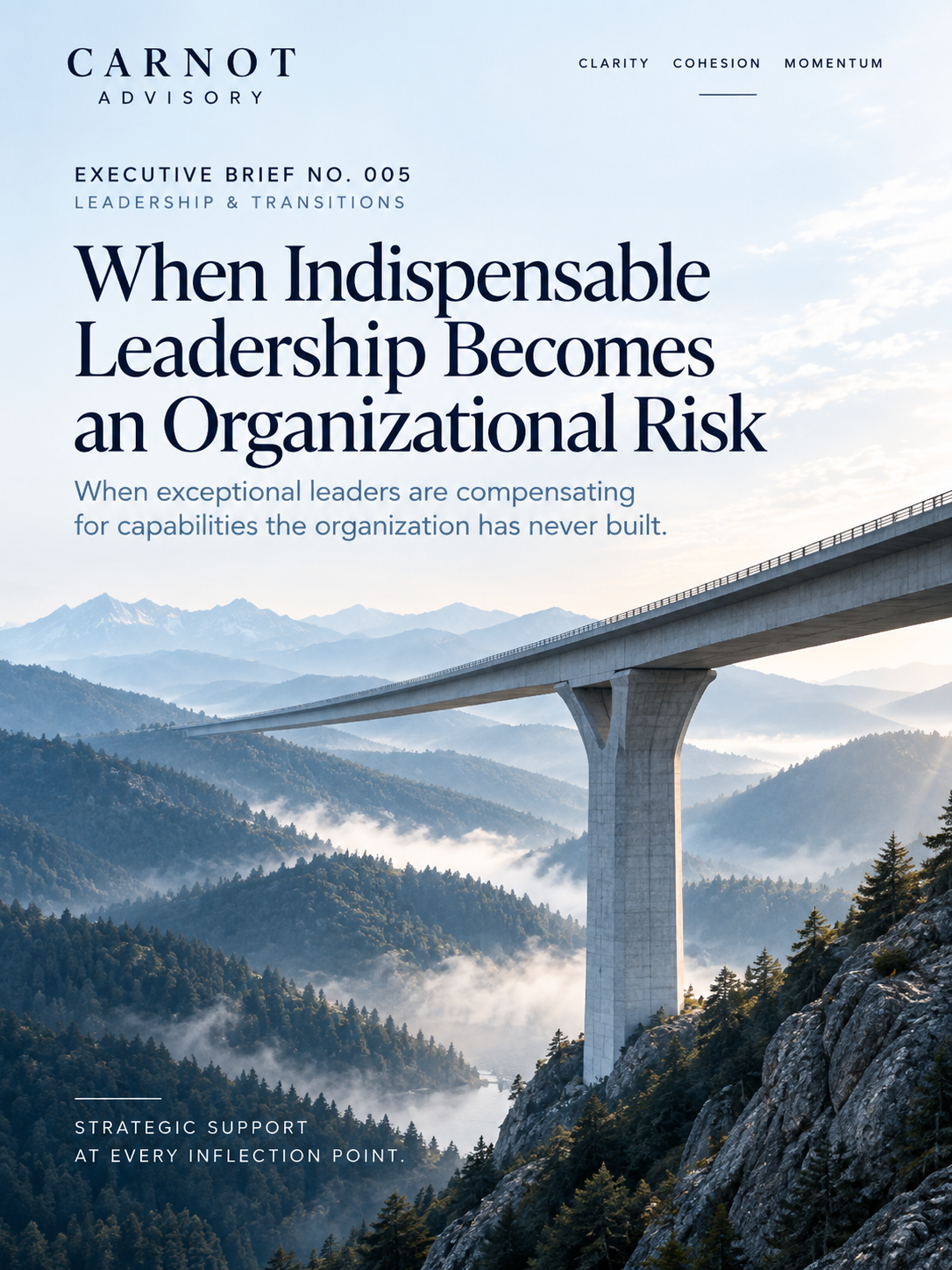
EXECUTIVE BRIEF NO. 005 | LEADERSHIP & TRANSITIONS
When Indispensable Leadership Becomes an Organizational Risk
Exceptional leaders can strengthen an organization. They can also quietly compensate for capabilities the organization itself has never built.
One of the most revealing sentences in any organization is:
“We can’t afford to lose her.”
Sometimes that is simply recognition of an exceptional executive. Sometimes it is a warning.
High-performing leaders often become indispensable because they are carrying far more than their formal role.
·They know which relationships matter and why.
·They remember why key decisions were made.
·They understand where the informal vetoes are.
·They resolve conflicts no formal process quite covers.
·They connect information that lives in different parts of the organization.
·When something stalls, they know exactly whom to call.
From the outside, this looks like extraordinary leadership. Often, it is. But it may also mean the organization has quietly built itself around one person.
Individual capability can hide organizational dependency
Organizations tend to recognize what an indispensable leader contributes. They are less likely to ask what the organization has failed to build because that leader has been contributing it.
Institutional knowledge may live primarily with one executive. Cross-functional coordination may happen because that person carries relationships across departments. Important trade-offs may get resolved through judgment that has never been translated into decision rules others can use.
Escalations may work because the leader knows how to navigate the informal organization. Critical work may keep moving because someone is compensating for unclear handoffs, weak processes, or unresolved authority.
The organization can appear healthy precisely because the leader is absorbing the friction.
That creates a dangerous form of organizational strength: one that depends on an individual continuing to compensate for weaknesses in the system.
Transitions expose what the organization was borrowing from the leader
This dependency often becomes visible only when something changes: a senior executive leaves, a founder steps back, a business is sold, the next generation takes over, a company is acquired, a long-tenured leader retires, or a successor is promoted.
At that point, the obvious question is usually: “How do we replace this person?” But replacement may not be the whole problem.
What would stop working if this person stopped compensating for the system?
That question changes the diagnosis. Instead of asking only what experience, relationships, or capabilities the successor needs, it asks what the organization itself should become capable of doing without relying on one person.
A successor can inherit a title without inheriting the informal authority of the predecessor. A buyer can acquire the company without acquiring the founder’s institutional memory. The next generation can assume ownership without inheriting the relationships, judgment, and unwritten operating logic that made the business work.
The transition exposes the gap between the organization as designed and the organization as it has actually been operating.
The real succession question is larger than who comes next
Succession planning often focuses heavily on identifying and preparing the next leader. That work matters. But successor readiness and organizational readiness are not the same thing.
A highly capable successor can still struggle if the organization expects them to reconstruct an operating system that previously lived inside someone else.
Before a transition, organizations should ask what the departing leader is actually carrying - not just responsibilities, but capabilities.
·What decisions depend disproportionately on this person’s judgment?
·What relationships allow work to move because formal mechanisms do not?
·What institutional knowledge exists primarily in one person’s memory?
·Which cross-functional conflicts reliably migrate to this leader?
·Which processes work because this person knows how to work around them?
·Where does the organization depend on their informal authority?
·What would become slower, less reliable, or more political if they were no longer present?
The organization may not simply be losing a leader. It may be losing infrastructure.
Founder-led and closely held businesses face an especially important version of this risk
Founders often provide much more than strategic direction. They may be the organization’s primary source of integration.
They carry customer history. They know the unwritten boundaries around pricing, risk, hiring, spending, and exceptions. They understand which relationships require personal attention. They know why the business evolved the way it did. They resolve ambiguity because everyone ultimately knows where authority sits.
That can work remarkably well for years. Then a sale, acquisition, succession, or next-generation transition occurs - and suddenly the organization discovers how much of the business was still living inside the founder.
This is one reason ownership transition can be more complicated than transferring equity or naming a successor. The business may also need to transfer - or build - judgment, authority, information flow, coordination mechanisms, and institutional memory.
Without that work, the new owner or successor inherits a company whose formal structure may remain intact while its actual operating capacity has changed dramatically.
The goal is not to eliminate exceptional leadership
The answer is not to make talented leaders less important. Strong organizations still benefit from exceptional judgment, relationships, creativity, and leadership.
Make sure individual excellence strengthens the system rather than substitutes for it.
That means asking whether important capabilities remain trapped inside particular people or are becoming institutional.
·Can others access the information required to make good decisions?
·Are decision rights clear enough to survive a leadership transition?
·Do important cross-functional issues have a place to be resolved?
·Can another capable person enter the system and succeed without reconstructing its unwritten logic?
·Does the organization learn from the leader - or simply rely on them?
Those questions distinguish a strong leader from an organization that has become dependent on one.
A better test of organizational resilience
An organization is not resilient simply because it currently performs well. A more demanding test is whether it can continue to perform when the person compensating for the system is no longer there.
That is why indispensable leadership deserves closer examination. Sometimes “we can’t afford to lose her” is a tribute. Sometimes it is diagnostic evidence. And sometimes the most important succession work begins by asking what the organization must learn to carry for itself.
The goal of succession is not simply to replace capability. It is to determine which capabilities should no longer have to live inside one person.
DIAGNOSTIC QUESTION
What would stop working if this person stopped compensating for the system?
The answer may tell you as much about the organization as it does about the leader.
CARNOT ADVISORY
Clarity • Cohesion • Momentum