
EXECUTIVE BRIEF NO. 004
GOVERNANCE & OPERATING EFFECTIVENESS
The Org Chart Is Not the Operating System
Formal authority describes the designed system.
Behavior reveals the experienced system.
Strategic support at every inflection point.
THE ORGANIZATION ON PAPER
Most organizations can explain how authority is supposed to work.
They have org charts, job descriptions, committee structures, approval thresholds, delegation matrices, and policies that define responsibility.
All of those things matter.
But none of them, by themselves, tell us how the organization actually operates.
A role can have clear authority on paper and still discover that decisions are routinely reopened.
A leader can be accountable for an outcome while the critical levers remain somewhere else.
A stakeholder can be described as consultative and still exercise informal veto power.
A board can delegate authority to management and then undermine that delegation through the questions it asks, the decisions it revisits, or the people it contacts directly.
The designed system may be clear.
The experienced system may be something else entirely.
And when those two diverge for long enough, people learn which one matters.
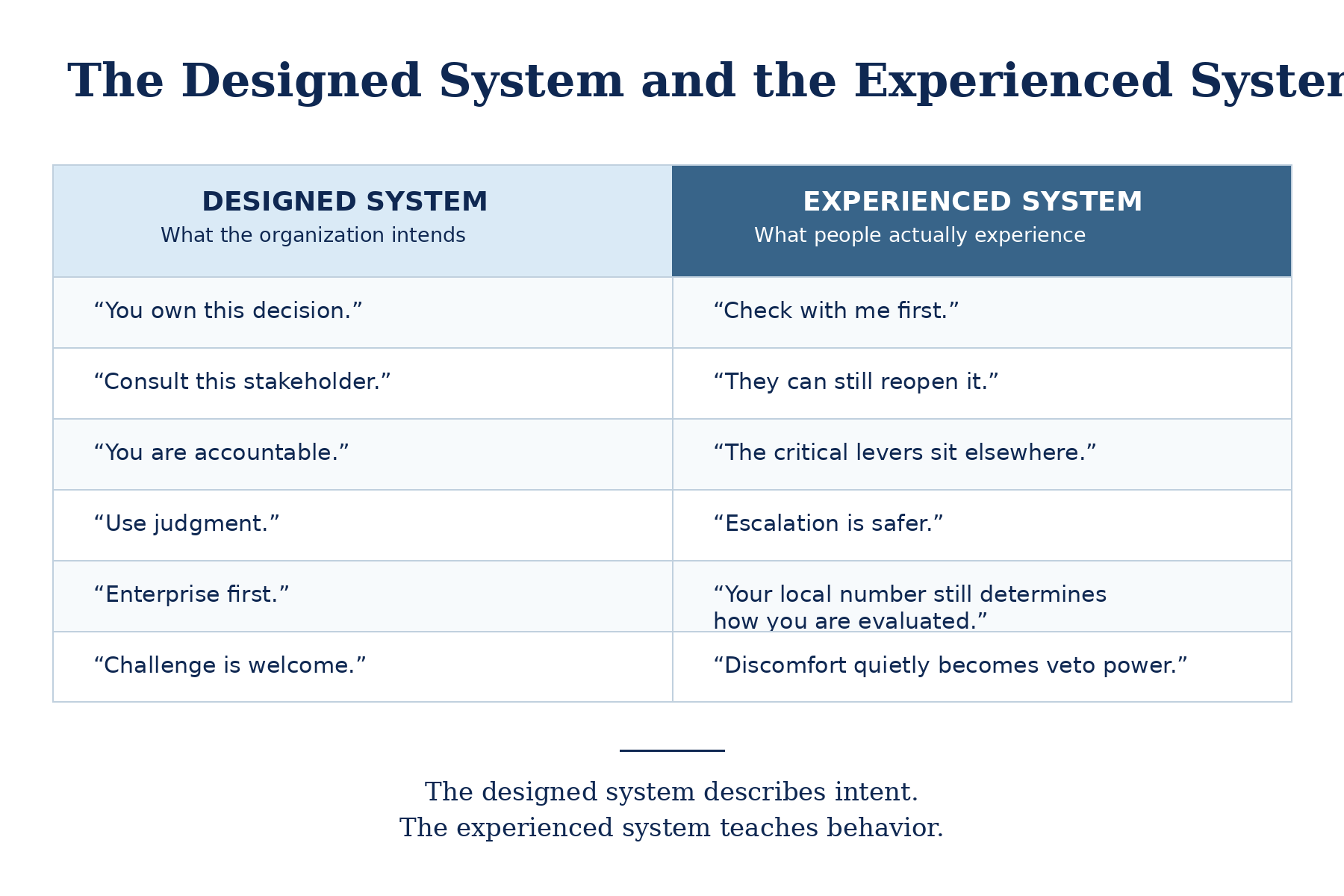
THE DESIGNED SYSTEM AND THE EXPERIENCED SYSTEM
Designed system:
“You own this decision.”
Experienced system:
“Check with me first.”
Designed system:
“Consult this stakeholder.”
Experienced system:
“They can still reopen it.”
Designed system:
“You are accountable.”
Experienced system:
“The critical levers sit elsewhere.”
Designed system:
“Use judgment.”
Experienced system:
“Escalation is safer.”
Designed system:
“Enterprise first.”
Experienced system:
“Your local number still determines how you are evaluated.”
Designed system:
“Challenge is welcome.”
Experienced system:
“Discomfort quietly becomes veto power.”
The designed system describes intent.
The experienced system teaches behavior.
THE REAL OPERATING SYSTEM APPEARS AFTER THE DECISION
One of the fastest ways to understand an organization is to watch what happens after someone exercises the authority they were given.
The meeting ends.
The decision is clear.
The owner is clear.
The next step is clear.
Then the real system appears.
Someone who disagreed goes to another leader.
A stakeholder who was consulted behaves as though they had approval authority.
A decision is reopened because the consequences became uncomfortable.
A board member reaches past the CEO.
An executive learns that using judgment carries more political risk than escalating.
Nothing on the org chart changed.
But the organization just taught everyone something important about how authority actually works.
PEOPLE LEARN THE EXPERIENCED SYSTEM
People learn organizations quickly.
They learn not only from policies and role descriptions, but from what happens when those policies are tested.
If a leader makes a reasonable decision within their authority and the organization supports it, others learn that authority is real.
If that decision is routinely second-guessed, routed around, or reopened, they learn something else.
They begin to seek approval they technically do not need.
They soften recommendations.
They delay action.
They escalate decisions they could make themselves.
They learn which stakeholders carry informal veto power.
Eventually, leaders may appear indecisive inside a system that has quietly trained them not to decide.
What looks like a leadership problem may actually be an operating-system problem.
AUTHORITY IS NOT INSTITUTIONALIZED UNTIL IT SURVIVES USE
Delegation is easy to describe.
It is much harder to sustain.
Authority becomes real only when it survives being exercised.
That does not mean decisions should never be challenged.
Healthy organizations should welcome new evidence, contrary information, and legitimate reconsideration.
But there is an important difference between challenge and undeclared veto.
A decision should be revisited because something material changed.
Not simply because someone with influence dislikes the outcome.
If an executive can technically make a decision but knows that using that authority will trigger end-runs, political pressure, or routine reversal, the formal authority exists only on paper.
The practical question becomes:
What happens when someone exercises the authority they were given?
That answer often tells us more about the operating system than the org chart does.
ACCOUNTABILITY WITHOUT REAL AUTHORITY
The problem becomes even clearer when accountability and authority separate.
A leader may be responsible for an outcome while another function controls the budget.
A shared-service team controls the process.
Technology controls the system.
Risk controls approval.
A vendor controls part of execution.
Escalation sits somewhere else.
The accountability remains clear.
The authority does not.
In complex organizations, few leaders control every variable affecting an outcome. They do not need total control.
They do need sufficient authority over the critical levers — and a reliable mechanism for resolving the ones they do not control.
Can they make the decisions the outcome requires?
Can they secure resources without unnecessary escalation?
Can they resolve cross-functional conflicts?
Can they challenge constraints that materially affect the result?
And where another function holds a dependency, is there a mechanism that actually resolves the trade-off?
If not, accountability may be assigned on paper while the operating system makes the outcome structurally difficult to own.
INFORMAL VETO POWER IS STILL POWER
Some of the most consequential authority in an organization never appears in a governance document.
It may sit with a founder.
A board member.
A long-tenured executive.
A donor.
A senior functional leader.
A stakeholder whose influence exceeds their formal role.
The issue is not influence itself.
Influence is unavoidable.
The issue is whether the organization is honest about where consequential authority actually sits.
When formal decision rights point in one direction and informal power points in another, people learn to navigate the informal system.
That is when shadow governance begins to replace formal governance.
And once people learn that formal authority can be overridden without a clear process or accountability, they stop trusting the architecture.
THE COST OF DIVERGENCE
When the designed system and the experienced system diverge for long enough, predictable patterns emerge.
Decisions migrate upward.
Meetings multiply.
Leaders become cautious.
Cross-functional issues remain unresolved.
Strong performers become translators, fixers, and human middleware.
People spend more time reading the political environment.
Responsibility concentrates around the people who know how to make the organization work.
The organization may still perform.
But some of that performance is being subsidized by work the system itself does not know how to do.
That is fragility.
WHAT EXECUTIVES AND BOARDS SHOULD EXAMINE
A useful diagnostic is not simply:
Are decision rights clear?
The stronger questions are:
Which decisions are formally delegated but routinely escalated or reopened?
Where does consultation function as unofficial approval?
Who has influence or veto power that the formal structure does not acknowledge?
What happens when a leader exercises judgment and the outcome is uncomfortable?
Do accountability and the ability to influence the outcome actually sit together?
Where do decisions migrate upward under pressure?
Which people have become essential because they know how to navigate the organization’s unwritten rules?
Can a capable newcomer determine what they own, what guides the decision, and when escalation begins without reconstructing the operating logic from scratch?
The answers reveal the real system.
A MORE DURABLE WAY TO OPERATE
The goal is not to eliminate disagreement.
It is not to make every decision permanent.
And it is not to create a rigid rulebook.
The goal is to build an operating system in which people understand:
what they own,
what guides their judgment,
where the boundaries sit,
when escalation is appropriate,
and what will happen when they exercise the authority they were given.
That is what allows responsibility to move through the institution instead of returning repeatedly to the same people.
A durable operating system is not the one the organization has documented.
It is the one people can reliably use when the decision becomes consequential.
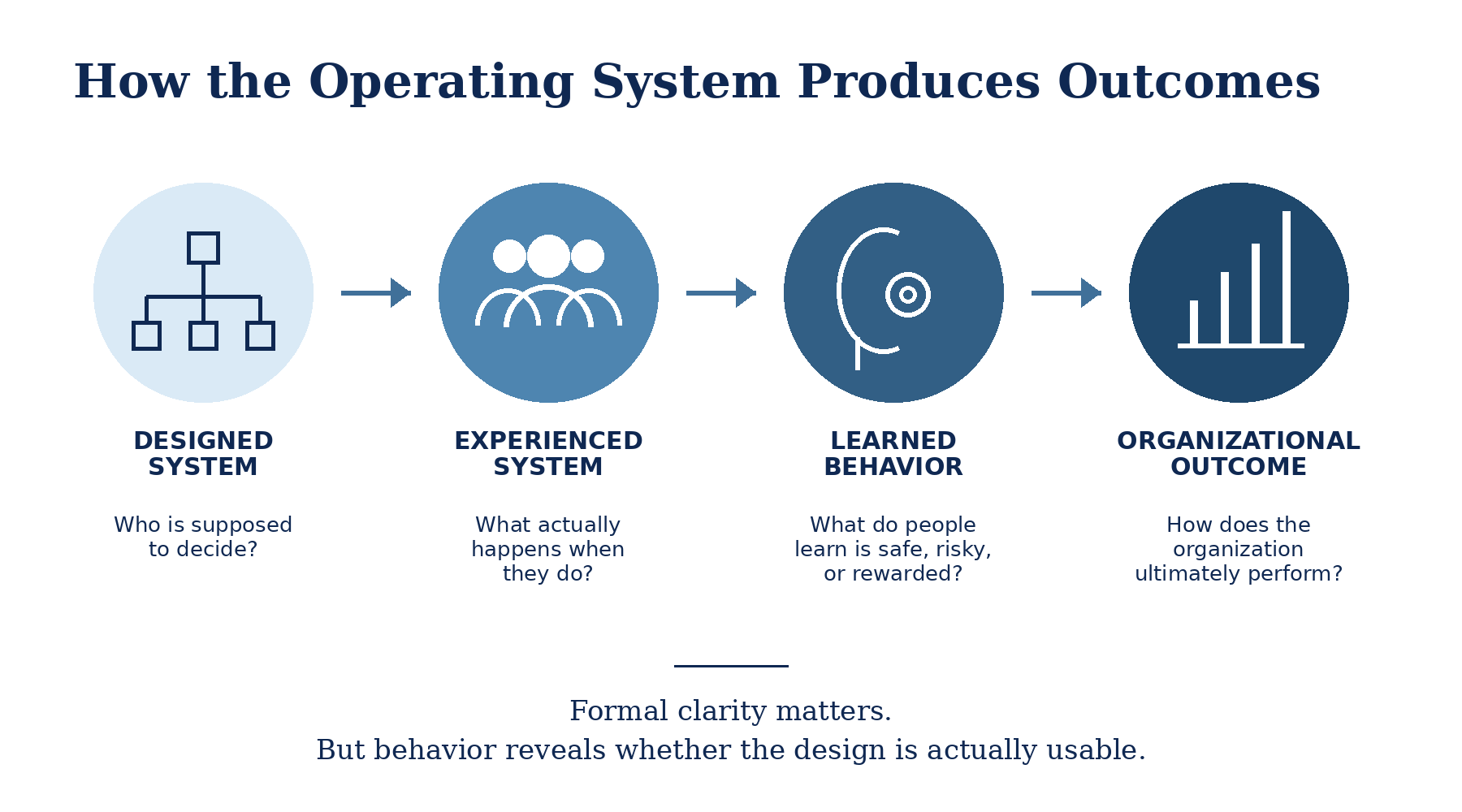
The org chart shows the designed system.
Behavior reveals the experienced system.
The difference between the two is where organizational risk often hides.
Strategic support at every inflection point.
Clarity • Cohesion • Momentum